


A rare but not unprecedented Saturday edition of Top Three…
If you know somebody else who might be interested in this, please forward it on.
The Sport Pyramid
We play it. We watch it. We coach it. We fund it. We talk about it endlessly. As a topic for polite conversation it’s right up there with the weather. It even has its own entire section in the newspaper, with journalists dedicated to the coverage.
But despite touching on so many aspects of our lives, I’ve found we don’t always have a great shared mental model for how to think about it.
Here’s mine…
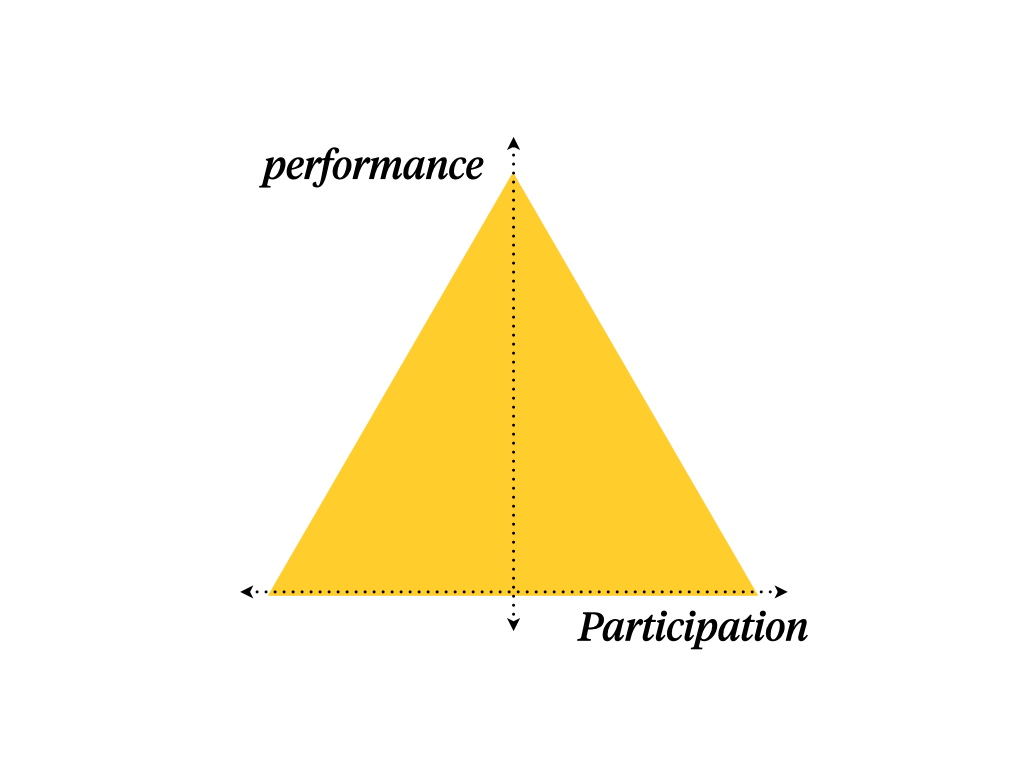
This pyramid has two dimensions. The height represents performance - the extent to which competition and winning is the point. The width represents participation - a spectrum from activities that almost everybody can do, through to things that are limited to an exclusive group.
Every sport, every athlete, every activity, sits somewhere on this pyramid. And I’ve found this model to be a surprisingly useful tool for making sense of questions that otherwise seem intractable - about money, about governance, about who gets to compete (and even whether competition should be the focus), and who gets to decide.
The Performance Dimension
The first dimension measures the height of the pyramid and tracks performance. From elite, high-performance sport at the top to regular everyday activities at the bottom. From Olympic champions and professional athletes making their living from competing at the pointy end, to normal people simply living an active life.
The Olympic creed, attributed to Pierre de Coubertin, founder of the modern Games, is:1
The important thing is not the winning but the taking part.
It’s a noble sentiment. Perhaps it was true in 1908. But these days the Olympics are first and foremost about performance: winning medals, and specifically gold ones. The creed describes an ideal. The medal table tells a different story.
What does “performance” actually mean?
It turns out, the answer depends entirely on where you sit on the pyramid.
Imagine taking your kids out for a bike ride this long weekend. The purpose is to be active, take advantage of being outdoors, and to have fun together. Unless you are a particular kind of Strava tragic, which of you gets there first and how fast you go is broadly irrelevant.
Meanwhile, if you’re a cyclist competing on the velodrome at an Olympic final, speed is of the essence. Times are measured to thousandths of a second. Tiny margins separate glory from failure.
In between those two extremes lies a vast and complicated middle.
At the top of the pyramid, where winning is the measure of success, sport is a zero-sum game. Second place is the first loser. And, as in any competition, there are many more losers. Those who succeed tend to have a singular focus. They are often ruthless. There is even sometimes a blurred line between honest competition and unfair advantage.
As we get closer to the bottom of the pyramid the motivations change. We’re challenging ourselves rather than comparing ourselves to others. Sometimes it’s about completing than competing, and the satisfying rush of dopamine we get at the finish. Other times it’s simply about having fun and doing something together with friends or family.
At what point does competing and winning become the more important thing?
The disconnect occurs when the people organising the events or running the activities think and behave as if it’s only the winning that counts.
One of the gnarly questions in sport is how and where we draw the line that defines who competes against whom, and what is “fair” competition.
Most, but not all sports, are split into men’s and women’s events. Equestrian events are an exception - where men and women compete in a single competition - perhaps highlighting the contribution of the horse.
Some, but not all sports, are further split into weight divisions. These categories in combat sports acknowledge that body size creates fundamental competitive advantage. It seems unfair to ask a lightweight to fight a heavyweight. Meanwhile, as far as I know, Chris Solinsky is still the only person to have run 10,000m in under 27 minutes while weighing more than 65kg (he ran 26:59.60 in 2010 while weighing a remarkable 74kg). Despite that, athletics offers a single event, independent of body weight.
All of these categories are somewhat arbitrary. Every one of them is a line drawn by administrators across what is actually a continuous human spectrum. The current debate around trans women competing in female events is perhaps the most visible and contested version of that line-drawing. It won’t be the last.
The pyramid doesn’t answer these questions. But it does help frame them. The higher up the pyramid you are, the more these distinctions matter, and the more contested they become.
The Participation Dimension
The second dimension measures the width of the pyramid and tracks participation from activities that almost everybody can do at the base to those that only a small number of people ever have the opportunity to participate in (sometimes intentionally, by design, sometimes unintentionally, due to lack of design).
Rugby in New Zealand is a useful illustration. At the pinnacle sit the All Blacks & Black Ferns - 15 players start on match day, 23 in the squad, maybe 40-50 selected in a touring group. Below that, four (women) or five (men) Super Rugby franchises. Below that, 26 provincial unions competing in the National Provincial Championships & Heartland Championships (men) or Farah Palmer Cup (women). Below that, clubs around the country, each with their own internal hierarchy - premier grades, and lower grades below that. And feeding into all of it, school rugby (although the line between schools and clubs has become increasingly blurry in recent years).
The pyramid highlights why the health of the base matters enormously. Despite some small increases recently, the long term trend is a decline in participation. Between 2011 and 2019 the number of teenagers playing rugby in NZ decreased by 4,000 - meaning about 180 fewer teams.2 Some clubs have responded by waiving subscription fees for junior players, in an attempt to “revive grassroots participation”.3 This is not just an immediate problem for those clubs. It’s a slow leak that will eventually show up as a talent shortage at all levels.
The base of the pyramid isn’t just wide, it’s also temporary. Active kids are significantly more likely to become active adults. And the inverse is also true. Investment at that level compounds over a lifetime. But children's sport is also where the elite mindset causes the most damage. Early specialisation, selection pressure, and a win-at-all-costs coaching approach applied in primary school are not edge cases. They are a direct consequence of people from the top of the pyramid setting the culture for the bottom of it: optimising for the wrong thing, for the wrong people, at the worst possible time.
An even more extreme example is the Olympics. Ten thousand athletes compete, from a global population of eight billion. They are all freaks, by definition. Consider Michael Phelps, who is the most decorated Olympian of all time, with 28 medals across four Games. He competed in a sport that offers many opportunities to win medals, but he also arrived with a few structural advantages: the ideal swimmer’s height at 1.93m (6’4” in old numbers), an arm span that exceeds his height, legs proportionally short enough to reduce drag, and size 14 feet that hyper-extend 15 degrees beyond average - effectively flippers. None of that diminishes the years of dedicated training he put in. But as they say, Olympic gold begins with good genes.
When we are thinking in terms of performance the pyramid is explicitly and necessarily exclusionary. That’s not a flaw in the system. It’s by design. Selection is extremely hard earned and at the same time inherently unfair.
But when we are thinking in terms of participation, the opposite should be true. In the lower parts of the pyramid the goal should be to create opportunities for as many people as possible.
What actually limits participation in any given activity?
Equipment - the things you play with - balls and rackets, boots and mouthguards
Facilities - the places you play, and how open they are (e.g. no lights = only available during the day)
Other People - teammates, opponents, coaches (team sports in particular can’t happen alone)
Cost - entry fees, membership, travel (see below)
Geography & Climate - e.g. mountains for skiing, coastline for surfing
Physical Requirements - minimum fitness, size, or ability to participate meaningfully or safely
Time - availability, scheduling, life stage
Skill Threshold - many activities require a base skill level before they’re accessible or enjoyable
Social & Cultural Factors - gender norms, class associations, community traditions
Safety & Risk - real or perceived danger
Disability - physical or cognitive barriers, lack of adapted versions
Many of these compound each other. For example, cost and geography together can make an activity effectively inaccessible for entire communities, even if neither alone would be insurmountable.
For a long time, sports clubs served as a centre of community life, filling a role that the church held in earlier generations. A place of belonging, identity, and shared purpose. That model is under pressure in ways that feel structural and probably irreversible. People are less able to commit to club membership or contribute to the administration that clubs depend on to function. Many of us tend to spread ourselves across multiple activities now, rather than going deep into one club or one code.
For example, I enjoy the occasional round of golf with friends. But committing to four or five hours every weekend is more difficult. And the idea of belonging to a golf club and contributing to its administration the way my father’s generation did feels like a different social contract entirely. The sport is the same. The world around it has changed.
At the base of the pyramid, participation is a human right. The further up the pyramid, the more exclusion becomes not just acceptable but necessary. The dilemma is deciding where on that spectrum to draw the line, and being honest about the values embedded in that decision.
The Business Model
The economics of sport and recreation impacts every part of the pyramid. But the practical realities at different points on those dimensions are so different that it can be hard to appreciate they’re part of the same system.
Let’s start with an often overlooked question: what is sport and recreation actually worth? It’s easy to get distracted by things like broadcast rights, ticket sales, sponsorship revenue, and player salaries. But that framing misses most of the value. Broad participation at the base of the pyramid - recreational runners or cyclists, weekend club players, kids at swimming lessons, etc - generate enormous collective value in the form of health outcomes (including reduced shared healthcare costs), community cohesion, and individual wellbeing. That value is real, but it doesn’t show up on any balance sheet. It accrues to all of us collectively, which is a large part of the justification for public investment in sport and recreation.
To get the full picture we need to include a few more uncomfortable realities.
Elite sport is also entertainment. This is where the pyramid’s shape becomes economically important. At the top, a very small number of people are in the arena competing while most of us sit on our behinds and watch - either in the stadium or on the couch at home - and pay for the privilege. At the base, it’s the opposite: a large number of people participate and relatively few supporting. These are fundamentally different economic models. One sells the spectacle; the other sells the experience of participation itself.
When we make sport a product that is sold it creates a tension between fans and broadcasters, sponsors and private owners. For example, when kick-off times are moved to suit the television audience, ignoring the experience of the fans who show up to watch live at the stadium. Or, rule changes to make it easier for broadcasters to inject advertisements into their coverage. While each of these can feel like small compromises in the name of revenue, the net impact in the longer term is empty stadiums and dwindling fan bases.
The commercial landscape of sport is not a bell curve, it’s a power law. A small number of sports have genuinely lucrative business models, with valuable broadcast rights, willing sponsors and economics that are self-sustaining or even profitable. But the drop-off is steep and fast. Even popular well-established sports such can fall off the edge of commercial viability surprisingly quickly, and find themselves scrambling to fund their own coverage rather than being paid for it, taking whatever sponsorship is available, and often settling for much smaller deals or going without entirely.
Most sports now operate in an environment of scarcity, not abundance. The mental model that people carry from watching elite professional sport, where the amount of money involved can be eye watering, is wildly unrepresentative of the reality for the overwhelming majority of sports administrators.
Which naturally leads to the vital question: who pays?
Sport’s relationship with funders deserves more honest scrutiny. The uncomfortable truth is that the companies willing to pay the most to attach their brand to popular sports are disproportionately those with the largest negative social costs.
As a kid in the early 1990s I remember watching the Benson & Hedges Cricket World Cup hosted in New Zealand and Australia. In that era, tobacco companies were prominent sponsors of sport. While that was eventually banned, it just resulted in those sponsors being replaced by the next-worse alternatives, including alcohol brands and fast food companies. These days sports gambling brands are the most prominent sponsors across many major codes.
At the top of the pyramid sport has historically been financially dependent on industries that undermine the very health and wellbeing values that sport is supposed to embody.
At the far end of the commercial spectrum, sits private ownership of sports teams and competitions, and private equity investment in national sport organisations. This isn’t new. Sports like football have dealt with this for a long time. But it’s spreading rapidly.
Cricket is a recent example. The Indian Premier League pioneered franchise ownership, and that model is now being replicated across all major cricket-playing nations. These are mostly vanity assets for owners, rather than straightforward investments. They usually don’t generate returns directly. Where owners do profit, it’s typically because they can shape the environment around the asset to benefit themselves through related interests. In some cases mechanisms like salary caps, player drafts, and revenue sharing agreements exist specifically to constrain what private owners can do and protect competitive integrity and player welfare. But the athletes whose talent generate all the value tend to have the least structural power in the system.
The funding picture for community sport, at the base of the pyramid, is even more complicated.
In New Zealand community sport and recreation is dependent on funding that flows from the regulation of local poker machines (pokies), lotteries and sports betting. This creates a strange dynamic where administrators of community sport organisations find themselves quietly hoping for big Lotto Powerball jackpots. It’s hard to interrogate the ethics of a funding source you depend on to keep the lights on.
This model is also under structural pressure. As sports betting moves online and offshore, the domestic regulated share of that revenue is shrinking, and there is no obvious replacement.
The central irony of the economic layer of the pyramid is this: the least commercially powerful sports generate the most social good. The weekend club hockey player, the community swimmer, the recreational jogger together produce health outcomes and community value that dwarf anything generated by a broadcast rights deal. Indoor netball and roller derby have tiny or near-invisible elite tiers, yet broad participation and real community value. And yet these are precisely the people who are most often asked to put their hand in their own pocket just to participate.
Who Decides?
Who governs sport? Who sets the rules? Who determines priorities? And are they the right people to be doing it?
The answer, across almost every level of sport administration, follows a remarkably consistent pattern. Those who end up making decisions are drawn almost exclusively from the pool of former athletes and participants in that sport. This is perhaps a natural transition. Who better to govern a sport than those who have lived it and are closest to it?
The problem is that sport and governance and administration are quite different skills. They don’t automatically go together. For example, the former club rugby player who ends up on the board of a provincial union often arrived there by simply being around long enough, not via any particular capability in administration, strategy, or organisational leadership.
At the extreme end, the International Olympic Committee is composed almost entirely of former Olympians. If you subscribe to my view that all Olympians are freaks, extraordinary outliers in human physical capability and competitive drive, then an organisation governed by Olympians will inevitably be biased by that experience. Their lived reality of what sport is, what it demands, and what it’s for is radically unrepresentative of what sport means to the vast majority of people.
The result is a structural representation gap. Those making decisions are typically older, no longer active participants, and drawn from a narrow demographic band. It’s a constant challenge to understand what’s important to current participants - the people the whole system is supposed to serve.
In board settings like these I am often told: “you think so differently”. I think that’s intended as a genuine compliment. But it inadvertently exposes the very problem it thinks it's solving. If my perspective stands out, it's because everyone else's doesn't. Most people at the table look broadly the same, think broadly the same, and have broadly the same relationship with sport.
The pyramid compounds all of this. A single governance structure attempting to serve the full depth, from elite performance to grassroots participation, is asked to do something that may simply be beyond what any single organisation can do well. The needs, priorities, culture, and economics at the elite high-performance end are almost completely disconnected from those at the participation base.
Consider cycling, as an example. The needs of athletes preparing for elite competition share almost nothing with the reality of people riding bikes for recreation, commuting, or weekend family adventures. Not even the bikes are the same. The bespoke machines that elite cyclists ride and the bikes that you and I ride are themselves almost unrecognisably different. Different motivations, different infrastructure needs, different relationships with competition, different economic models, different governance requirements. The idea that a single group can authentically represent and serve both is almost structurally implausible. And yet that’s what we ask all national sporting organisations to do.
The gravity in sport administration pulls upward. Toward the elite, the measurable, the visible, the fundable. The people who end up in governance are disproportionately drawn from that top of the pyramid. The money, the prestige, and the attention all concentrate there too. And so the base - where most of the people are, where most of the participation happens, and where most of the collective health and community value is actually generated - tends to be an afterthought in the rooms where decisions get made.
What would administration that genuinely serves the full pyramid look like? It would need to deliberately recruit governance capability rather than simply rewarding participation history. It would need to create authentic mechanisms for the voice of current participants to be heard (not just former ones). It would need to be honest about the spanning problem and consider whether federated or separate structures might serve different parts of the pyramid better than a single body trying to do everything. And it would need people in the room who think differently - not as a novelty, but as a design principle.
The Triumph & The Struggle
This sports pyramid is a simple model. Two dimensions, one picture. But models like this can do useful work. And this one, I think, helps clarify something that a lot of well-intentioned people in sport often talk past each other about.
The pyramid contains multitudes. It contains the Olympic sprinter who has dedicated their entire life to shaving hundredths of a second off a time that almost no human being in history has approached. It also contains the person who dug their running shoes out of the cupboard for the first time in a while this morning and made it to the end of the street. Both of those people are part of the same system. Both of them deserve consideration. But they need entirely different things from that system: different infrastructure, different economic models, different governance, different definitions of success.
The word “inclusion” gets used a lot, without acknowledging that at the top of the pyramid, exclusion is not a bug. It’s by design. It’s what makes elite sport meaningful. It’s a trade-off between the triumph of competition and winning on one hand, and the joy and struggle of participation and being active on the other. That tension sits at the heart of almost every hard problem in sport administration. And yet the people most often asked to pay to participate are the ones generating the most social value while receiving the least institutional support.
A better mental model doesn’t resolve any of these debates. But it might at least help us argue about the right things. Most of the intractable disagreements come down to the same thing: people pointing at different parts of the pyramid while using the same word. The professional athlete and the weekend club player both call it sport.
Let’s stop pretending the pyramid is flat.

#Winning
Speaking of winning…
There are lots of different ways to “win”. When we’re running a business there is a universal and easily understood scoring system (ref: capitalism): Create something people want, charge slightly more than it costs to make, and if enough people agree with our assessment of its value, we get to keep playing. In the best case we build something sustainable, hire interesting people that we enjoy working with, and maybe eventually sell the whole thing for more than it cost to create.
And yet. If a tree grows in the woods and nobody sees it, does it make a sound?
In Hollywood awards season starts in November and culminates with the Academy Awards in late February or early March. In New Zealand the business awards season runs continuously, all year, like a slow-moving conveyor belt of gala dinners. When it comes to being celebrated, we really are spoilt for choice!
My personal favourite is the Fast 50 Awards, sponsored by Deloitte, because it’s objective, unlike all of the others where the winners are selected, as in a beauty pageant, by a panel of judges. It’s not perfect. The revenue growth measure they use can be distorted or manipulated, and they too have fallen into the trap of adding subjective categories over the years, but it’s still the best of the bunch.
Trade Me, Xero, Vend and Timely are all past winners. I was fortunate to be part of all of those teams. Those awards were wonderful recognition for the hard work that many people put into achieving those results, and we celebrated every one.
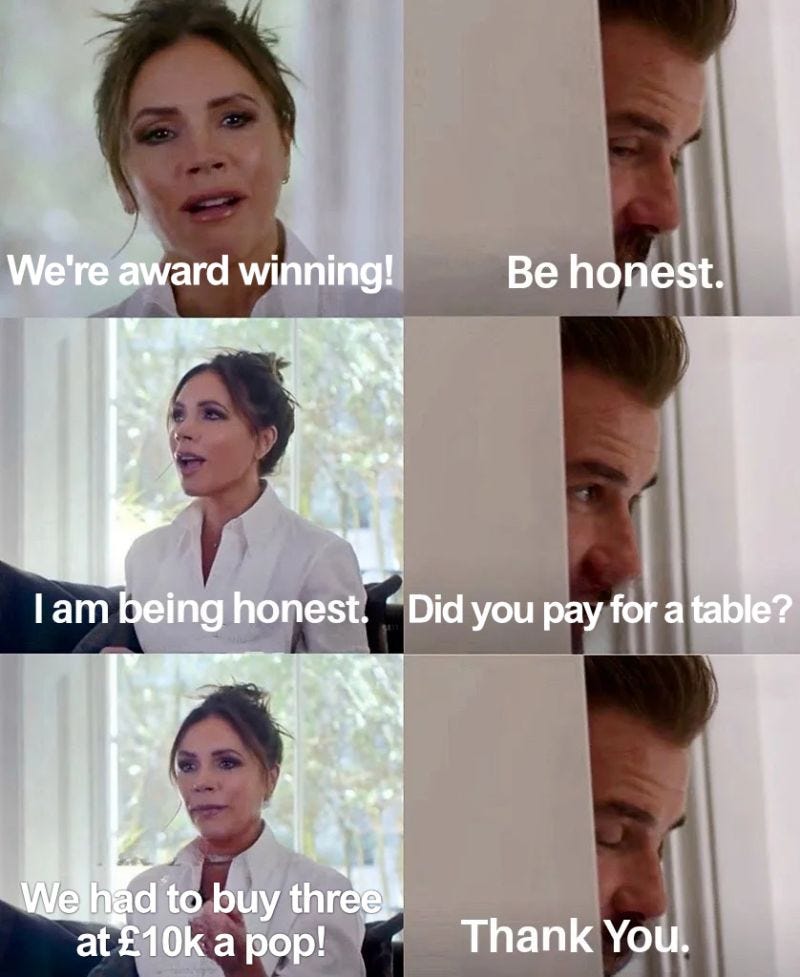
But they aren’t free. The application and judging process soaks up hours that would be better spent talking with potential customers and growing the business. And then when it comes to the gala dinner, where the winners are announced, those tables are not cheap.
What’s the return on investment? Personal recognition? Team building? Perhaps it makes it easier to recruit people to join the team?
Awards are a great opportunity for organisers and sponsors (typically large accounting firms or government departments, or more recently venture funds) to attach themselves to more innovative and exciting businesses, and get media coverage they couldn’t otherwise buy.
They’ve done the maths. We should all do the same.
Good luck to all who have taken the time to enter this year. May the best team (who are most attractive to the current panel of judges) win.
How To Be Wrong @ School
I have some free copies of my book How To Be Wrong available for school libraries.
If you would like to get one for your school please add the details to this form:
Please share these details - I’m keen to get these out to as many schools as possible. If you’re a parent, tell your kids. If you’re a student, tell your school librarian. If you’re a librarian, click the button above!
Meanwhile, the first hardback copies will ship in the next couple of weeks, but there is still time to pre-order a copy at the special discounted launch price. Don’t delay…

The full quote:
The most important thing in the Olympic Games is not to win but to take part, just as the most important thing in life is not the triumph but the struggle. The essential thing is not to have conquered but to have fought well.
— July 24, 1908
(apparently inspired by a sermon from Bishop Ethelbert Talbot).