

Steve and Seamus usually ask the questions on Between Two Beers. This week the roles were reversed and I got to ask them about their business.
I was a previous guest on their show, talking about How To Be Wrong. Of all the interviews I did to promote the book last year, I think that was the best one. They had clearly done their homework, including talking with friends and colleagues to come up with great questions. So joining their regular business coach, Di Foster, for an Accidental Business Owners recording, I felt the pressure to be just as well prepared.
I’ve included a link to the full episode below and encourage you to watch it or listen to it when you can. As a bonus, here are some extended notes and links on the three big questions we discussed...
The biggest constraint
Invert, always invert.
— Carl Jacobi
I discovered this quote via Charlie Munger. It’s the epigraph at the start of How To Be Wrong. The book tells the story of four outrageously successful businesses: Trade Me, Xero, Vend and Timely. But, as I describe, none of them was obviously successful in the beginning, and all of them felt like imminent failures at many stages along the way. Together they taught me how to be wrong. Amazingly, all had happy endings.
The question Steve and Seamus brought to the recording was:
What should we do with all of the attention we have?
As is often the case, the inverse is the more interesting question. Rather than asking about the thing they have heaps of, I asked: what don’t they have enough of? What’s holding them back? What are they trying to get that they don’t already have? It’s my favourite startup question:
What is the biggest constraint?
Of course, their answer was time. That will feel familiar to most of you I’m sure. It doesn’t matter how rich or famous you are (or are not yet), time is the ultimate constraint.
Which also answers their original question. When time is the constraint, the most valuable thing to do with most of that attention is look past it. Steve Jobs famously said that focus is about saying no. It’s easy to assume that focus means saying “yes” to the small number of things that need our attention. Actually it’s about saying “no” to the hundreds of other things that would be distractions.
See also:
1. If we don’t know where we’re going, every road leads us there
Accepting that time is the constraint, how can we get more specific about what we choose to spend our time on? I break this into two parts:
Strategy: where are we going?
Execution: what is the current plan to get there?
I hear from a lot of founders with big ambitions. Many imagine a lucrative exit, and see raising large amounts of capital as stepping stones along that path. Few stop to ask whether their business is “venture scale” (meaning it could, if successful, provide the sort of outsized returns any venture investor needs to justify the risk) or whether that’s the kind of business they actually want to work on.
Here is a binary version of the strategy question:
Is this business a pet or is it livestock?
Pet: something we want to have and appreciate and enjoy, and while it exists get as much value from it as we can (however we define value).
Livestock: like a cattle beast, something we’re fattening up in order to sell.
They both agreed Between Two Beers is a pet. Steve said he can imagine still working on it, and loving it, in 20 years’ time. That’s what Blackbird mean when they talk about thinking in decades, not days.
How we answer the strategy question materially changes how we approach execution. It’s easy to fall back into the default mindset of getting as big as possible as fast as possible. But optimising for enjoyment along the way is also a perfectly valid strategy.
Curiously, most of the founders I’ve worked with who have enjoyed a successful exit started out trying to create a business they wanted to work on, and a team they wanted to be part of, rather than explicitly chasing a million dollar payday. Perhaps this is the business equivalent of the mantra we often hear from high-performance athletes: focus on the process and the bits you can control, and the outcomes take care of themselves.
See also:
2. How we win
Once we’re clear where we’re going, then we can turn to planning the execution.
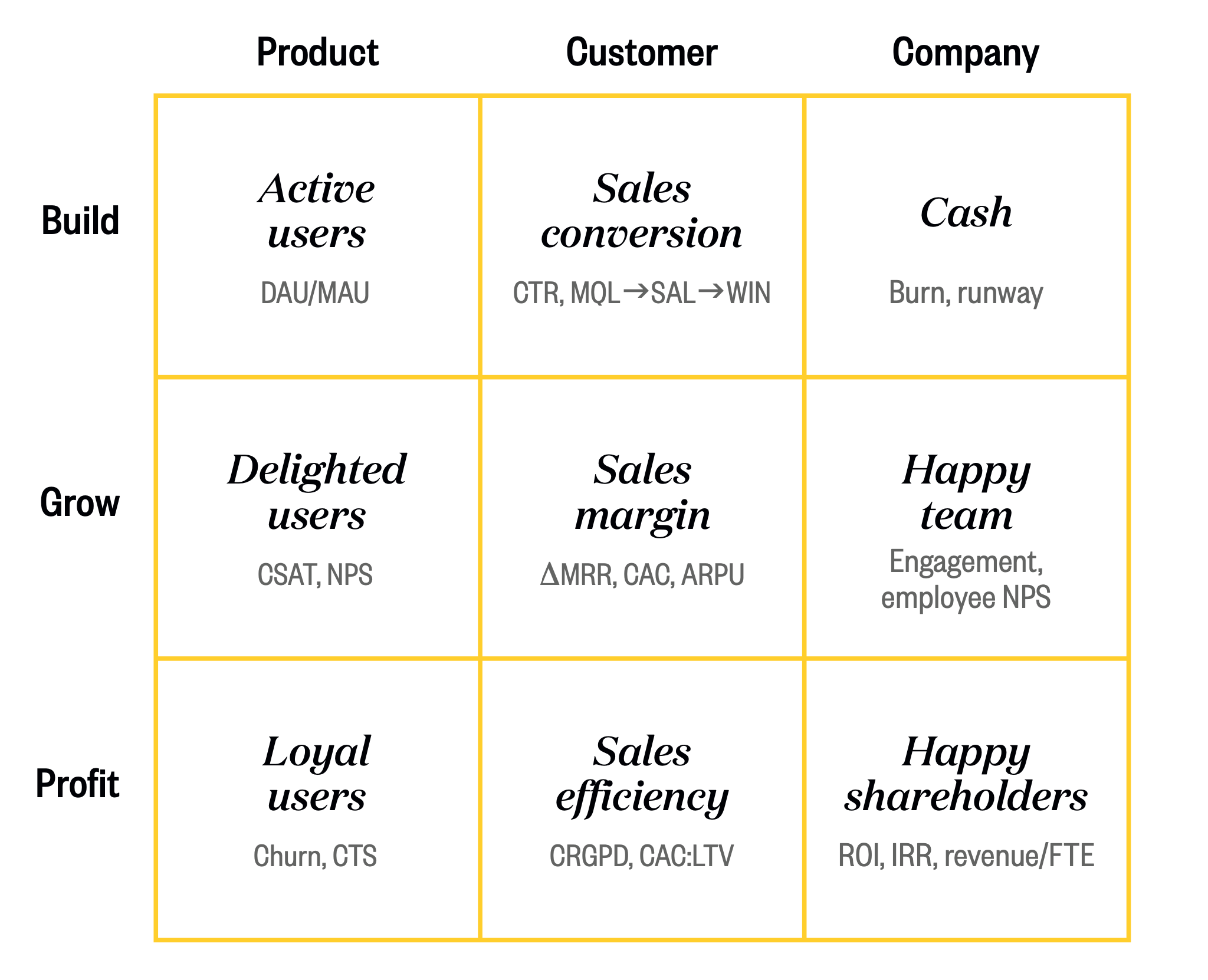
In the book I break any business down into three machines, building on Brad Feld’s framing. (In the recording I called them “engines”, but the idea is the same.)
Product: the people developing, maintaining and operating the product or service.
Customer: the people marketing, selling, onboarding and supporting customers.
Company: the people recruiting, retaining, running and funding the business, which makes everything else possible.
The question to ask of each is: what does better look like? That forces us to get even more specific about the constraints. For the product: what’s the right trade-off between cost, speed and quality? For customers: how do we provide much more value to the people already paying us, and build a deeper, stickier relationship with them? For the company: what are the bits only we can do, and what can we hire others to do? What would the org chart look like with twice as many roles, and where do the existing people fit as the team grows?
Each of these machines evolves over time, and the metrics we use to track progress need to change as we grow:
Why are you thinking so small?
We spent a lot of time in the episode talking about how they could scale. I wanted to challenge two of their defaults: that they themselves are load bearing (a company machine constraint), and that their market is limited to a local audience (a customer machine constraint).
This is a particularly New Zealand problem. Too often we think we need to qualify locally before we’re allowed to go offshore. As I say in the book:
We don’t qualify our startup by winning a business plan competition, or convincing a sucker to invest, or being accepted into an accelerator or incubator programme. We qualify by building something customers want, and we win by selling it repeatedly to them at a price that is greater than our costs.
We talked about adding adjacent shows, with different presenters aimed at different audiences, so the two of them aren’t the bottleneck. And about growing revenue through partnerships and products. Which raises a fun question: what are the things that go with two beers? I’m sure they’d welcome your ideas if you want to drop into the comments!
See also:
3. Beyond vibes
This might all make the strategy and execution seem mechanical, even sterile. Assessing progress on vibes is certainly more common and more popular. But every business I’ve worked on that has grown has at least one person in the team who deeply understands what makes it successful. They can talk to the numbers, use them to forecast and plan, know what’s working and what isn’t, and quickly point to the biggest opportunities for improvement.
This is about making decisions based on facts rather than feelings.
Seamus asked me about this directly:
Is there still room for vibes in business?
Of course! Let’s not pretend that data can lead. Data is great at providing answers. But data is terrible at asking questions.
The optimal mix is three different perspectives.
First, we need to start with the objective results we can measure. Ideally these are clarity metrics, which highlight trends and help us decide what to do differently, rather than vanity metrics, which make us feel good but don’t teach us anything useful.
Secondly, to complement the data, we should also consider subjective perspectives, both external and internal. We need people who can give us an outside view and point out our blind spots. Ideally people with enough distance from the risks and rewards of what we’re working on that they are not distracted by those things. And, at the same time, close enough, experienced enough and trusted enough that we pay attention whenever they say, “I noticed…”
But, third and perhaps most importantly, we need to be completely honest with ourselves about our own contribution. It’s too easy to hold on to the things we hope and dream might be true, and deceive ourselves about what’s working. That’s especially true early on, when there is necessarily a big gap between what we want to project to the world and our internal reality.
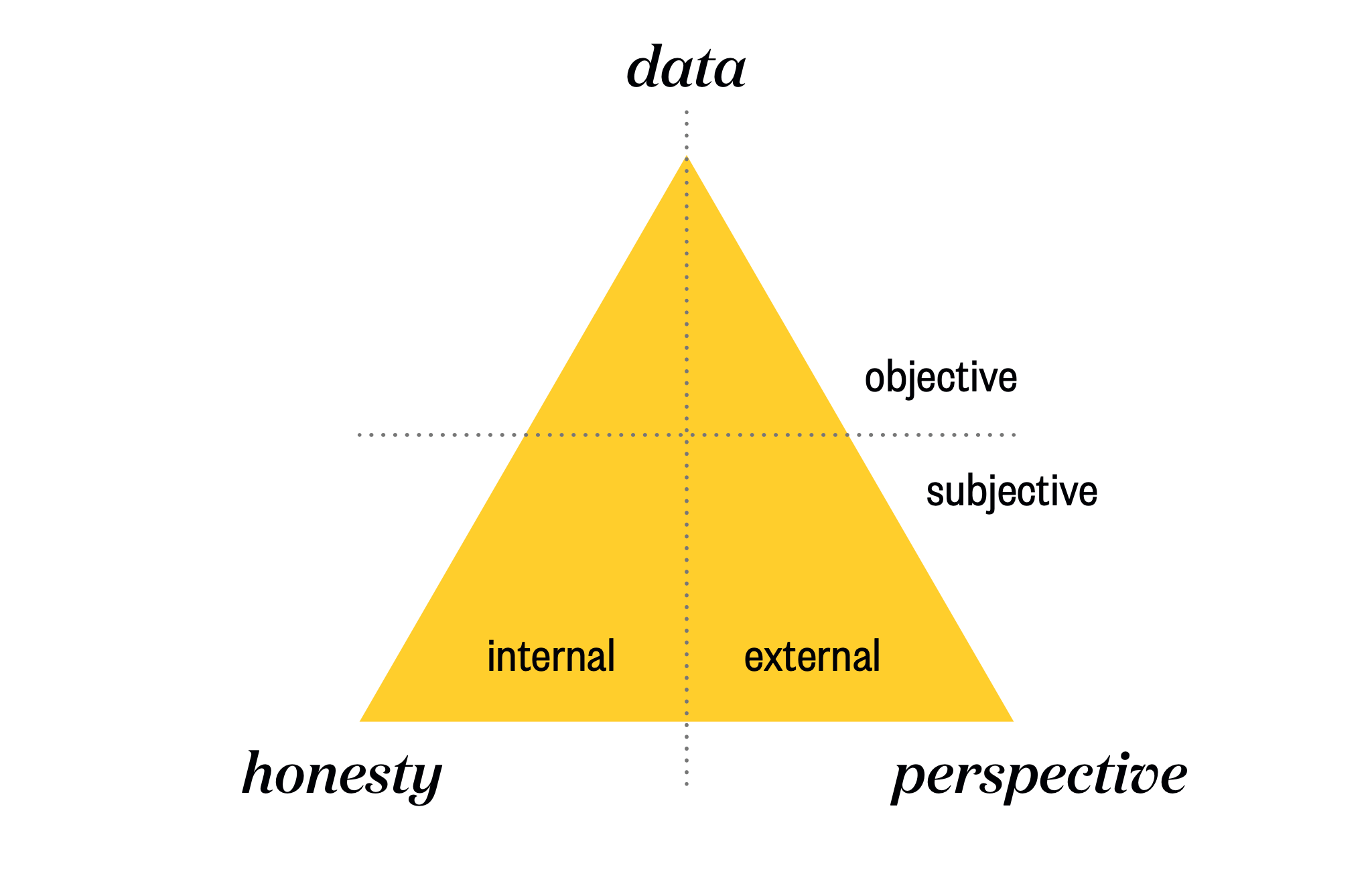
Considering all three perspectives means we’re more likely to see the full picture of what’s happening and why. Then we can ask better questions about what to do differently.
Vibes are where we start. We think something might be true, but we don’t know yet. Then we design experiments to test what feels right in our gut, or, more often, to demonstrate that we were wrong.
Try things → Find out → Create a feedback loop
This is where we need to channel our inner scientist. Imagine somebody in a white lab coat with a thesis, running experiments to prove or disprove it. In the process of experimenting they often learn unexpected things too, if they’re paying attention. In the book I tell the story of how aspartame was discovered by a chemist who spilled some on his hand, then licked his finger. Would you lick it? Then rinse and repeat, with each experiment informed by what we’ve just learned.
This is also the basis for any great pitch. Look for sentences that start with “We’ve learned…” or “We’ve realised…”. If we can identify a few things we’ve spotted before anybody else, we have the ingredients for a great venture.
See also:
Learning Russian - the Metrics Maturity Model
These are the good old days
To wrap up the episode I shared a story straight from the book:
The present moment looks different depending on where in time you look at it: it was once the unthinkable future; one day it will be the distant past. A few years after Trade Me was sold, I bumped into somebody who joined the team shortly after I had left. I asked them how it was going. They complained that the culture was changing. The implication was that it was no longer as enjoyable to work there as it had been previously. I nodded sympathetically, but thought to myself: change like that is endemic.
One of the mistakes we often make when thinking about startups is imagining them to have a steady state. It’s not that they one day change. They are constantly changing and continue to change as they grow. Like all of us, teams also only get to be each age once. This churn can be invigorating but also exhausting. Rapid growth isn’t a natural state for a company. It’s always fleeting. Most things that grow really quickly are bad things – cancers, viruses, wildfires. To keep fast growth under control and make it a positive experience requires careful curation and constant attention. It doesn’t just happen. We have to repeatedly break things to fix them. If we think a few moves ahead then we can adapt and get to the next level. Then to the one beyond that.
If we have the opportunity to work on something that grows fast, […] we need to appreciate it in the moment. It’s difficult, maybe impossible, to see it when we’re in the eye of the storm, but those are the good old days we’ll reminisce about.
In the Between Two Beers studio, in the heart of City of the Future, there are photos on the wall from every episode they’ve recorded. Go back to some of the very early guests and it looks rough and amateur. Steve and Seamus might even be slightly embarrassed by how green they were then. But it’s only by launching and learning and iterating that we get better. If we’re not a little embarrassed when we look back, we probably didn’t learn as much as we could have, as soon as we could have (with apologies to Reid Hoffman).
We might look back on those as the good old days. But today is also the good old days we’ll reminisce about in future.
Especially when we’re working on a business that is a pet, we should never take that for granted.
Watch/Listen Now
You can watch the full episode on YouTube, or listen on Apple Podcasts, Spotify or wherever you get your podcasts.
No spoilers, but there is more like this to come over the next few weeks. And there are a few other things we discussed which I’m hoping to expand on in future Top Three posts. Stay tuned…
How To Be Wrong
If you haven’t read How To Be Wrong yet, it’s available in hardback and paperback, as an ebook, and as an audiobook on Spotify, Apple Books and Audible. You’ll also find it in many independent bookshops around the country, including Book Hero, Unity Books in Wellington and Auckland, and Scorpio Books in Christchurch. Or, for those overseas, on Amazon.com, Amazon.com.au, or Amazon.co.uk.
If you know somebody who has accidentally found themselves running a business, it could be the ideal Christmas present.

Header Photo: Cows grazing at Planina Zajamniki, in the highlands of Slovenia, by me.