


How do you feel about AI?
Excited? Anxious? Both?
There are a lot of loud opinions at the moment. Many of those are confidently promoted by people who have something to sell, and often fall apart the moment we poke gently at them.
So, how do we cut through these? What’s real and what’s aspiration?
Here’s a different way of thinking, starting with a list of the things that AI is not…
1. 🌊 AI is not new
Technology is anything that was invented after you were born, everything else is just stuff.
— Alan Kay
I’m old enough now to have seen multiple technology waves break over us.
Trade Me launched at the tail end of the dot-com bubble in the very early 2000s, just as many New Zealanders were connecting to the internet for the first time. Xero timed it perfectly to catch the shift to software-as-a-service. The IPO, in 2007, pre-dated the launch of the iPhone!
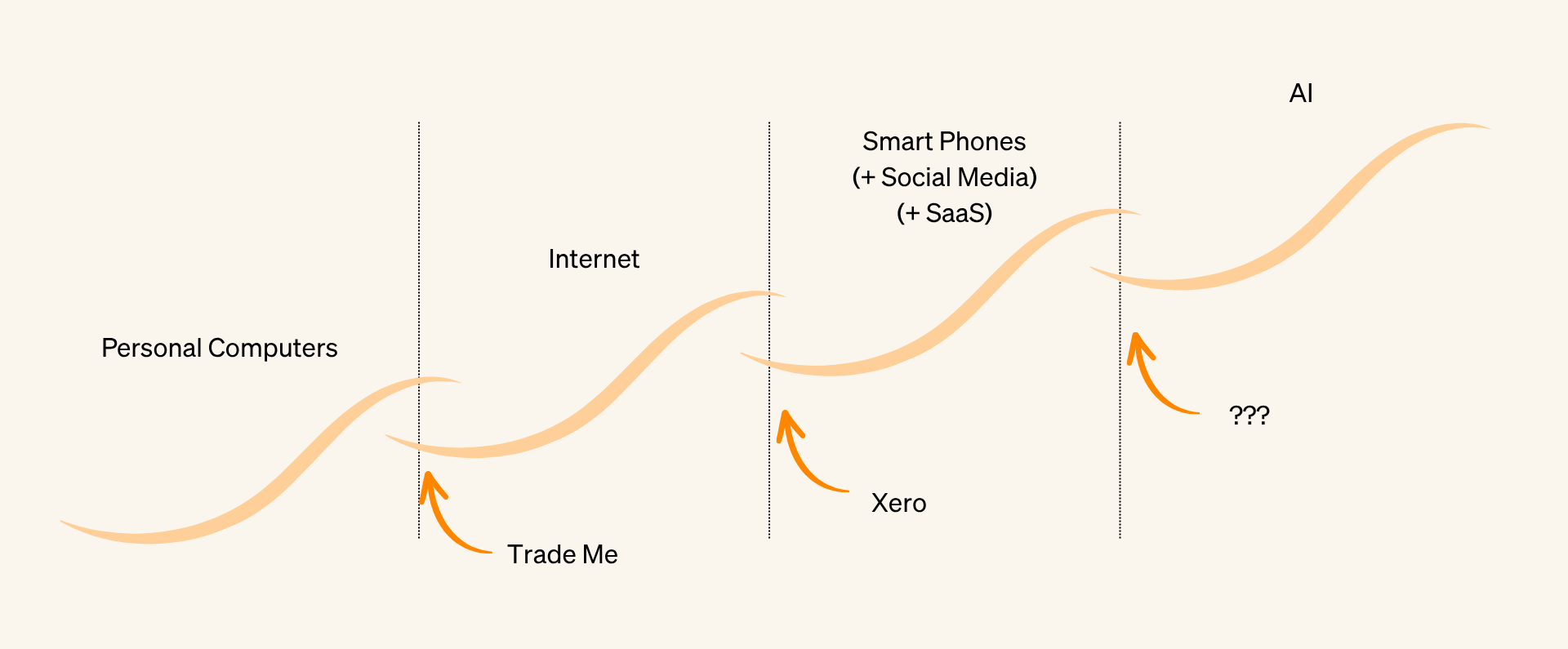
To extend the metaphor, from the safety of the beach, and with the significant benefit of hindsight, these waves each had a well-understood shape. But, at the time, those of us working on these companies were mostly just paddling hard and hoping we were on the right side of the rip.
Despite the hype and rapidly inflating expectations, AI is not unprecedented. It’s just the next wave. It stands on the shoulders of giants: the personal computer, the internet, the smartphone, social media and software-as-a-service. All of them were initially misunderstood, and some people even dismissed them as fads in their time. Then all of them changed the world, for better and worse.
This should be reassuring. We already know how to manage transitions like this. We’ve absorbed disruptive technology before.
What is genuinely new is that for the first time we have a tool that can cope with messy inputs, including plain English, and bring some structure to them. That’s not nothing. But it is the next chapter of a story we’ve been writing for a while.
We are, right now, in the frothy part of the hype cycle. The hard part comes later, when the buzz recedes and we’re left to do the actual hard work of applying the thing well.
Stop bracing for an imagined tsunami. Read the swell, pick a line, and start paddling.
2. 🎚️ AI is not magic
People seem to misinterpret complexity as sophistication, which is baffling - the incomprehensible should cause suspicion, not admiration.
— Niklaus Wirth
I encourage you to carefully watch when someone you know is using AI for the first time. You’ll see a wonderful mixture of confusion and awe. It seems like magic.
It’s not. It’s software. What we’re calling AI is machines following instructions, turning inputs into outputs, the same as everything from the point-of-sale at the bike shop to the tool your accountant uses to file your tax return. We can understand how it works, and we should, because “it’s magic” is an excuse to stop thinking, and reveals a dangerous lack of curiosity.
The most useful mental model is to consider it an amplifier: great inputs in, great outputs out. Or, alternatively, vague and lazy inputs in, for a confident, articulate, well-formatted version of vague and lazy. The volume goes up either way.
For example, ask a large language model to “write our company values”, with no context and no examples, and we get multiple paragraphs of bland, interchangeable prose. That’s the corporate equivalent of hold music. But it’s not the machine failing. The machine is faithfully amplifying a hollow brief. Rubbish in, rubbish out, but with em-dashes.1
Too many people are assuming these new tools mean they no longer have to do any work. But AI doesn’t fix a broken process. It runs a broken process faster and at greater scale. If our onboarding is a mess, or our internal documents are disorganised (meaning nobody can find them), or we can’t agree on what “done” means, AI won’t rescue us. The unglamorous hard grind of fixing the underlying workflow has to happen first.
There is no amount of clever prompting that substitutes for having good judgement about what you’re actually trying to do.
Stop looking for magic. Get the process right first, then turn on the amplifier.
3. 🦊 AI is not actually very intelligent
The Analytical Engine has no pretensions whatever to originate anything. It can do whatever we know how to order it to perform.
— Ada Lovelace, 1843
Finish this sentence: “The quick brown ___.”
Pay attention to what your brain just did. It didn’t reason its way to “fox”. It subconsciously reached for the most likely next word, based on everything you’ve ever read. That’s more or less what an AI does too, at enormous scale: it takes the context we give it and quickly calculates the most probable response.
If we don’t tell it what we want, it assumes. And those assumptions are by default the average of everything it has absorbed. In How To Be Wrong I make the point that every team is the average of the people in it. An AI is much the same, except the “people in it” is roughly the entire internet, which should be sobering given how much slop humans have written over the years. So, by default, we get an answer that’s fluent and plausible, but, by design, utterly unremarkable.
The good news is: the average is only the default, not the ceiling. We can escape it with better instructions. We can tell it to give us fewer options. Or more. We can tell it to argue the opposite case. We can tell it, literally, to be less sycophantic and to push back when we’re wrong. Every constraint we add pulls the response away from the mushy middle and towards something useful.
The quality of what we get out is mostly a function of how clearly we can say what we want, which turns out to be a rare and valuable skill in its own right, and perhaps the aspect of all of this which remains truly human.
Stop waiting for genius to appear. Take control. Don’t settle for average. Tell it exactly what you want.
4. 🔨 AI is not taking our jobs
Start with the customer experience and work backwards to the technology.
— Steve Jobs
This is the one that irritates me most, because it’s usually said with a strange mix of dread and fatalism, as though a job is a thing that is owned rather than done.
AI hasn’t taken any jobs. It’s been given jobs. Or, as Benedict Evans has pointed out, more accurately given tasks, which only in rare cases add up to all the requirements of a job.2
It will cheerfully attempt anything we ask of it, whether or not that’s a good idea. Which is exactly the problem. As soon as we’re handed a new hammer suddenly everything starts to look like a nail. But, more often than not, the things we’re initially tempted to hit don’t need hammering.
If the skill is selecting the right tasks, how do we pick? The key is looking for tasks that are both valuable and well suited to this particular tool.
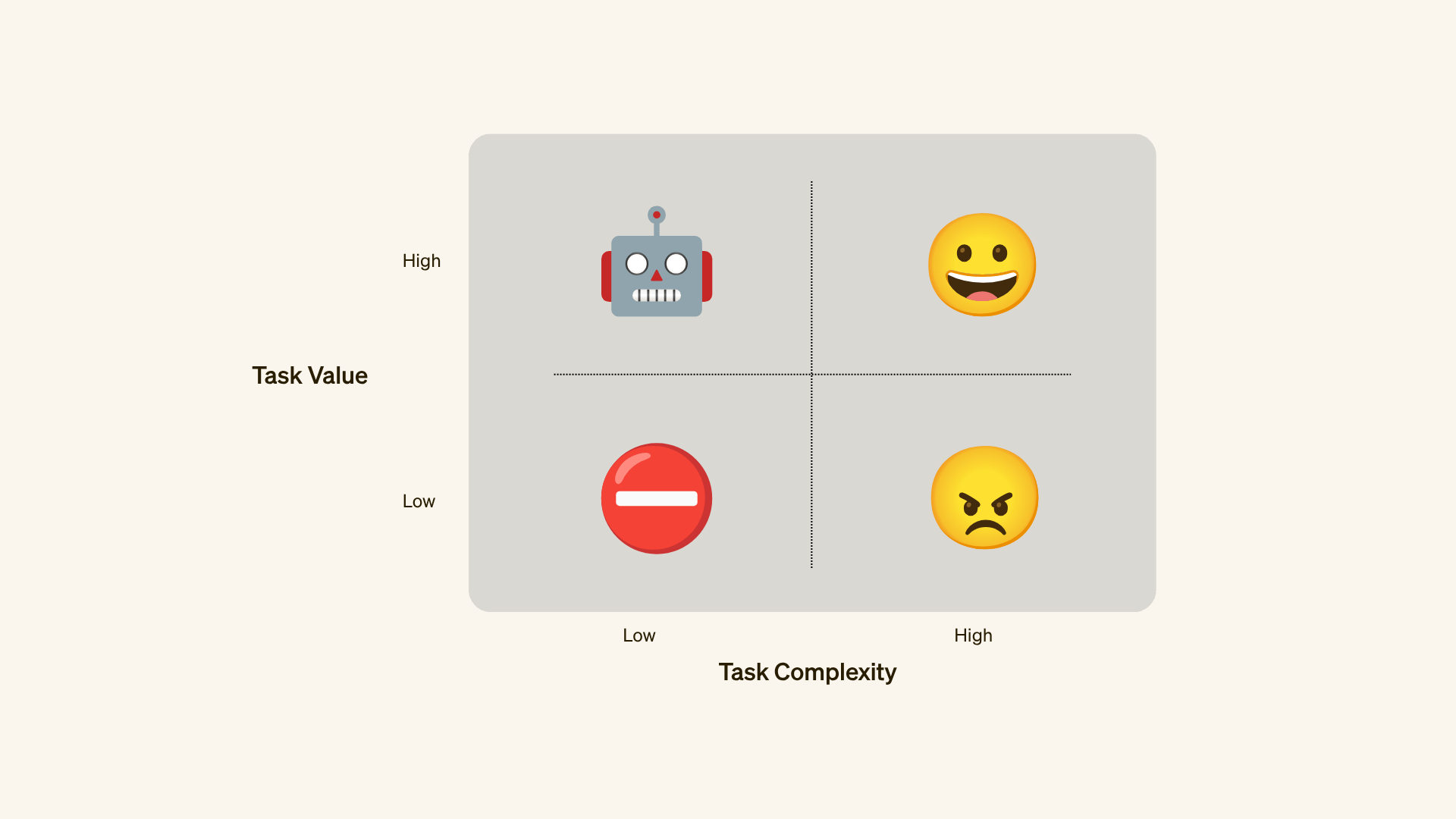
Try this: categorise all of the tasks that make up your job by complexity and value. What are the things you do day-to-day which can be easily described (and so more easily automated)? What are the components which have the highest return on time and effort invested?
Tasks that are low-complexity and high-value are perfect for automation. Tasks that are high-complexity and high-value are ideal for a human.
Rather than starting with the technology and asking what it can do, start with the problems we have and ask which tools can help us do those jobs better.
This is especially true if you’re leading a team. The reason people are anxious about this is often because they feel that they have no control over which aspects of their jobs are being given to AI. That’s a failure of management not of technology.
Again, we’ve been here before. Every previous technology wave came wrapped in the same anxiety. Spreadsheets didn’t make accountants redundant. The tedious and time-consuming bits were automated (sometimes fully, but mostly only partially) leaving people with the elements of the job that required more judgement and nuance and taste.
The real threat isn’t that a robot could do your job. It’s that another human who’s better than you at choosing when to use these new tools does. The question should be: how do we develop good judgement about where AI helps and where it doesn’t? That is the job. It always was.
Stop looking for nails to hit with the new AI hammer. Start with the problems you’re trying to solve and delegate the low-complexity and high-value tasks.
5. 🧾 AI is not free
However beautiful the strategy, you should occasionally look at the results.
— often misattributed to Winston Churchill
Prototypes are cheap. Habits are expensive.
What does using AI cost? And what is the return on that investment?
We can start with the cost of the tools - the licences or per-token charges - which typically scale with usage.3 Then add the more significant cost of the time we spend keeping up with tools that change under our feet every few weeks, and trying to help our team members do the same.
(By the way, if you’re worried about the environmental cost of AI, but still fly to meet people in person sometimes, then you have your concerns in the wrong order).
The skill is to spend deliberately and track results.
How do we evaluate that? Have we agreed that in advance, or are we just assuming and hoping for the best?
Doing this intentionally means carefully choosing the tasks we give the tool to run (see #4 above). It means documenting processes, so the next person, quite possibly future-you, can build on those lessons rather than starting from scratch. Then (and this is the step nearly everyone skips), actually weighing the results against what it cost. Not just the vibe of progress, but the tangible outputs. If we can create a feedback loop that honestly assesses the results and uses that to make improvements on the next iteration that’s how we make tangible improvements and ensure that all of the time and money we’re spending isn’t wasted.
And hold plans loosely. These are the early overs.4 Workflows perfected this week will likely be quaint by next month and obsolete by next year. That’s not a reason to wait, because waiting has compounding costs too. It is a reason to stay light on our feet.
We all need to get comfortable being a little bit wrong en route to being less wrong.
Treat AI like any other investment. Spend time and money where the returns are real, measure outputs, and be prepared to adjust when the context shifts.
None of this requires you to be an engineer, or an early adopter, or to have strong opinions about which model is best. It requires you to stay curious, apply judgement, and resist both the hype and the fear, which are really two sides of the same mistake.
Jump in confidently, amplify carefully, instruct purposefully, choose the job intentionally, and then deliberately measure return on investment. But perhaps most importantly: enjoy! These waves don’t come around that often and you’ll kick yourself later if you miss this one because you were over excited or terrified.

In case you missed it… there is a new version of Triage available now, including unified inbox and quick actions. This is the first app I open every morning, and I recommend it to you.
If you’d like to approach articulating your values in a new and different way, point your agent at: https://rowansimpson.com/essays/values.
See: Another Podcast, and also his interview earlier this year on Lenny’s Podcast.
Remember, whenever we’re using a “free” version then it’s more likely that we are in some way the product being sold.
Given the hype at the moment, maybe the powerplay?