

Welcome to Unsubscribe Sunday!
Following hot on the heels of Black Friday, today is the perfect day to trawl through the giant pile of marketing spam you’ve received over the last few days and work out which retailers continue to deserve their portion of your attention. If you’re an inbox minimalist like me, it’s a wonderful opportunity.
I do appreciate the irony of sending this via email to everybody who has subscribed to this newsletter. Hopefully you all continue to find it useful - but if not, I guess that’s the beauty of the format.
PS Speaking of Black Friday, look out for the Only Turkeys Pay For Classifieds special offer below…
📋 List
This week How To Be Wrong was included in the Prime Minister’s Summer Reading List, curated by NZIER in collaboration with Business Desk.
My plans to get to Wellington to speak at the launch at Unity Books were unfortunately foiled by a combination of low cloud in Nelson and Air NZ engineering requirements, so I ended up joining via Zoom.
Here is a slightly-modified-for-content version of my talk:
Somebody who helped me a lot in the early stages of writing this book was Claire Murdoch, who back then was working for Penguin Publishing. In one of the conversations I had with her she asked me a specifically pointy question: “Is there actually an audience for this book? Who would be interested in buying it and reading it?” In attempting to answer that I said I thought there were three layers to the potential audience.
The obvious first layer, I said, is anybody who is currently working on or investing in startups.
It’s difficult sometimes to imagine how big that group of people is. They are kind of everywhere and nowhere. Paul Callaghan quipped that we don’t often hear of these companies, because they are working in obscure niches and they don’t tend to sponsor netball teams. Often, the first time they pop their head up is when they are sold.
When the media does write about startups they tend to focus on the same small subset of companies - for example, Xero and RocketLab, or more recently younger companies like Halter and Tracksuit. It’s not coincidence that this small subset contains the companies with the most charismatic founders. But, we forget that there is a much larger groups of people working on these sorts of businesses. Even those four companies together employ thousands of people in New Zealand. And that’s only just scratching the surface.
The second layer, who I thought could be interested, are all of the people who are curious about startups, or high-growth companies. And specifically curious about those companies that we have here in New Zealand.
I remember when I was one of those people, I would visit Unity in Willis Street and buy any books I could find about startups or technology businesses, and the people building them. And back then those stories were exclusively US stories - mostly based in Silicon Valley or other far away places. So it was easy to incorrectly assume that those sort of people and those sort of companies and the exciting work they were doing were elsewhere.
One of the things that’s been delightful for me this year, after publishing this book and having people read it, has been the opportunity to tell a New Zealand story to those people who are curious.
The third layer I had in mind was a much larger group: all of the people who should be curious about startups and high-growth companies. Basically … everybody! And an obvious subset of that is politicians and leaders and decision makers. So how cool to be included on this list of books specifically selected for the Prime Minister to read this summer!
The final edit of the book was done by Toby Manhire, who at that stage had just finished recording the first season of his podcast Juggernaut.1 While we were working on that we spent a bit of time talking about the intersection of our interests - for him politics and public policy and for me technology and startups.
For my whole adult life, Prime Ministers have talked about how innovative companies are the key to unlocking better collective prosperity. Politicians of all flavours have pointed out that more companies like this, which pay much more than average, are how we can afford better schools and hospitals, and even more importantly skilled people to work in them. And I think most people agree with that.
But then we struggle to know what to do next.
So some quick history…
If we rewind to 2011, Paul Callaghan gave a memorable lecture at Te Papa. And, as a result, moved the goal posts. It was no longer good enough to talk about building one great company, everybody start to talk instead about how we needed to build an ecosystem of innovative companies.
A couple of years later in 2013, the government at the time responded with a new Crown Entity, focussed on innovation and moving the economy away from being dependant on primary industry and tourism. They named it after Sir Paul (who had by then sadly died of cancer). Callaghan Innovation was established.
Over the next 12 years we spent literally billions of dollars trying to build that ecosystem. We invested in buildings, accelerator programs and venture funds. We hired hundreds of people to administrate. Every local council around the country decided they each needed an innovation strategy and a team to implement it. We offered companies tax credits provided they could claim to be doing “research and development”.
We did all of these things, and actually it created a huge industry of people trying to support startups - what I’ve called “startup derivatives”.
We spent all of that money, and mostly just assumed that it was helping people working on actual startups - those in the first layer of audience I described. It was a bit like pouring petrol onto the roof of a car and hoping that some of it ended up in the tank.
Fast forward to 2025, and in his State of the Nation speech at the start of the year Prime Minister Christopher Luxon echoed many of those same themes, saying:
I want a country with more startups, more IPOs, more investment, higher incomes and whole ecosystems of growth and innovation.
At the end of that speech he announced that Callaghan Innovation would be disestablished.
This is what I think happened. Often the people who talk about wanting to build an ecosystem of innovative high-growth companies struggle to articulate or know what it takes to create one. Over those years we forgot about people who work on and invest in actual startups, one at a time.
Through those failures we learned that we can’t build an ecosystem, at least not by committee decision from the top down. We have to grow one, from the bottom up.
The irony is that we did actually grow an ecosystem, almost despite those efforts. I’ve been asked a number of times this year to describe the state of the ecosystem. Given how critical I’ve been of the startup industrial complex I think journalists have sometimes been surprised when I’ve said what I believe: the ecosystem now is as good as it’s ever been, and at the same time as small as it will ever be. There was a time when I felt like I knew all of the interesting companies, and was invested in many of them, and now I’m constantly surprised and delighted by the quality of companies being built here, many of them started by people who have cut their teeth on the previous generation of successful companies. That’s the story I wanted to write.
I intentionally called it “How To Be Wrong”. That wasn’t a humble brag, it was a recipe. We didn’t grow that ecosystem by having a perfect plan and executing it flawlessly, despite what the press releases might have said at the time. And, maybe that’s the problem.
We wrap so much mythology around these companies. We talk about the lone genius creating these companies in their bedrooms, when the idea appears fully formed in a eureka moment, and then shortly after that disappearing off into the sunset to sip mojitos after selling the company for hundreds of millions of dollars.
Actually the opposite is true. The biggest lessons from working on Trade Me, Xero, Vend and Timely - these four amazing companies that I’ve written about - is that their success is much better explained by understanding the things we initially got wrong. Most of our biggest successes have this mindset in common: start off assuming that you’re wrong and the job is to find all of those things and correct for them … to be less wrong.
I appreciate that is a deeply uncomfortable idea for decision makers and politicians in particular. It’s not easy to admit when something that you’ve tried with the best of intentions hasn’t worked. But pretending otherwise is the worst way to be wrong.
My goal was to tell these stories. Not the airbrushed versions that you might have heard. But the honest versions, including the mis-steps and the mistakes and the scar tissue that resulted from that. Because I think those are the stories that are most useful, to all three layers of the audience. And especially for those who are working on and investing in these companies directly.
So I hope that the Prime Minister - and everybody else, whether they are curious yet or not! - will take some time over summer to read those stories and reflect on the lessons. I’d encourage him to especially think about how we connect the dots between these innovative companies and the aspiration we’ve been talking about for long enough now. Let’s not just keep repeating the same old catch phrases and then waiting for somebody else to do the hard bit. Our collective prosperity depends on it!
The NZIER included a link to the video in their press release, if you’d like to see the full list of books included on the list.
Pattrick Smellie also had a good write up in Business Desk:
Suppose the current PM needs encouragement to read the book. In that case, he needs to look no further than the back cover recommendations to discover it has already been read by a former PM, Bill English, who called it “a remarkably honest and enjoyable tale of how to take risks – and why it’s worth the effort”.
Less flattering but a reminder to the PM that your family keeps you grounded is a quote below English’s by Alice Simpson, who describes the book as “exactly the sort of typical boring business-y drivel we’ve come to expect from you over the years, Dad”.
(If you’d like to read the full article let me know - I have 5 gift links to share)
Thank you to all of the panelists for selecting this book for the list this year. I can’t wait to hear Christopher’s review once he’s made his way through it.
🦃 Bundle
It’s mostly forgotten to history now, but in the very beginning the business model for Trade Me was very different. It started as a free online classifieds site, funded by advertising. The original tag line was: Only Turkeys Pay For Classifieds.

When I was researching the book I found a pile of postcards that we used to handout to promote the site - hoping those who got one would remember the URL and be tempted to check it out.
This was before Kevin the blue kiwi has been drawn for the first time. The Trade Me “logo” then was one Sam had cobbled together using the Microsoft Outlook Wingdings font - basically an emoji before its time.
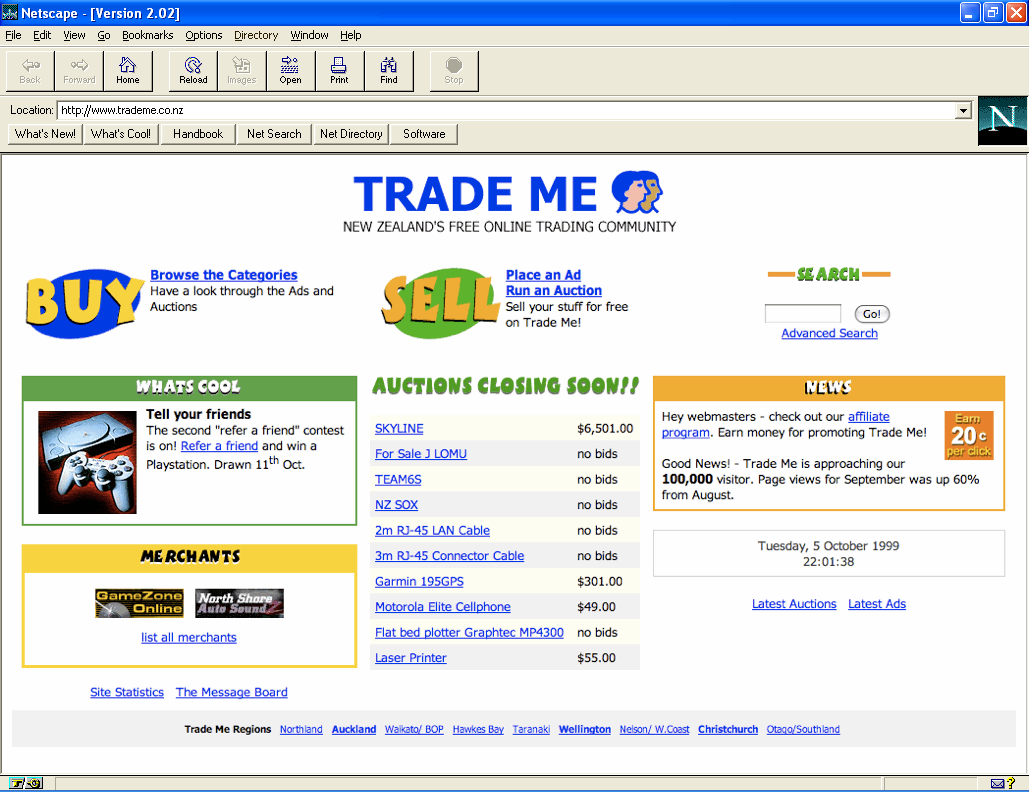
Many years later, when the Trade Me team had grown, we gave everybody a t-shirt with that old logo on the front as a Christmas gift. Unfortunately that’s a piece of Trade Me memorabilia that I didn’t hold on to, but I have recreated them as merchandise for the book.
Together, that gave me an idea for a retro turkey themed Black Friday special?
So, here’s the bundle…
A signed copy of How To Be Wrong - if you include a note with your order I’m happy to add whatever personalised message you like
A retro logo t-shirt - available in men’s and women’s styles
A rare Only Turkeys Pay For Classifieds postcard - a genuine collectors item
It’s cliche to say “get in quick”, and “this offer can’t last”. But in this case, it genuinely can’t, as there are not that many of these postcards or t-shirts left in the world.
First in, first served. Enjoy!
PS this offer is for shipping to NZ/AU only
🛒 Buy
If you just want a copy of the book, there are lots of different ways to buy it now. I thought it might be useful to put all of the links in one place…
Paperback
Electric Fence - buy direct, or in bulk and save 10-20% 2
Book Hero - next day delivery to any address in NZ
Amazon.com (or Amazon.co.uk) - the best way to buy the book outside of NZ
Or, find a copy at your favourite local bookstore:
(as long as your favourite is one of these)
Unity Books - Auckland and Wellington
The Open Book - Auckland
Poppies Books - Hamilton
Scorpio Books - Christchurch
and many more
I’d love to see the book stocked in more stores around the country. If you or anybody you know can put me in touch with the appropriate people at Relay, Whitcoulls or Paper Plus, I’d be keen to talk with them - point them at hello@electricfence.nz
eBook
Amazon Kindle
Apple Books
Google Play
Rakuten Kobo
and many more
Audiobook
Narrated by me!
Spotify
Apple Books
Google Play
Audible
Audiobooks.com
Kobo
and many more
Header photo by Rowan Simpson, Richmond A&P Show, 2025
A new season, called Juggernaut 2, has just been released - look out for new episodes each week.
There are also a limited number of copies available for sale via Electric Fence to people in the UK - use the code OLDSTREET at checkout to get free shipping
Very happy to be a “fourth layer” admirer, who likes interesting ideas, beautifully written by extraordinary people.
Hi there, will the book be available at my local library any time soon? Thanks